Choosing the right pool heat exchanger can make a big difference in heating speed, efficiency, and long-term reliability. The best models match your pool size, heat source, and plumbing setup without adding unnecessary complexity.
In this roundup, we focus on practical buying factors like material choice, port configuration, and BTU rating so you can narrow down the right option faster.
Best 10 Pool Heat Exchanger Picks for 2026
High-Capacity Stainless Pick
AB 300K 316L Same-Side Pool Heat Exchanger

- 300 kBtu/hr output for pools up to 23,800 gallons
- 316L stainless steel for corrosion-tolerant service
- Same-side ports and broad heating compatibility
Best For: Large freshwater pool and spa systems
Compact Shell-and-Tube Pick
RIYI 210K Compact Shell-and-Tube Exchanger

- Triple-pass tube bundle for efficient heat exchange
- Compact design with low pressure drop
- Works with heat pumps, solar panels, and gas boilers
Best For: Compact pool systems with multiple heat sources
High-Output Performance Pick
VEVOR 360K 316L Pool Heat Exchanger

- 360K BTU/h output for demanding heating needs
- 7.4 ft² transfer area with 30 capillary tubes
- 316 stainless steel and leak-tested brazed build
Best For: High-capacity pool, spa, and hot tub heating
Saltwater-Ready Titanium Pick
AB Titanium Opposite-Port Salt Pool Exchanger
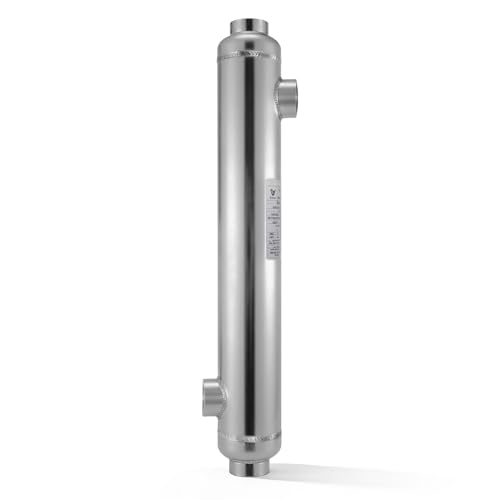
- 99.99% pure titanium for salt, seawater, and chemicals
- Opposite-side ports for 1 1/2" pool and 1" hot-water lines
- Sized for pools up to 11,900 gallons
Best For: Saltwater pools and corrosive-water applications
Compact 304 Stainless Pool Heat Exchanger

- 304 stainless steel resists rust and saltwater
- 200 kBtu/hour output for efficient heat transfer
- Compact body includes a mounting bracket
Best For: Homeowners needing a compact heater for pools, spas, or hot tubs
Heavy-Duty 316L Pool Heat Exchanger
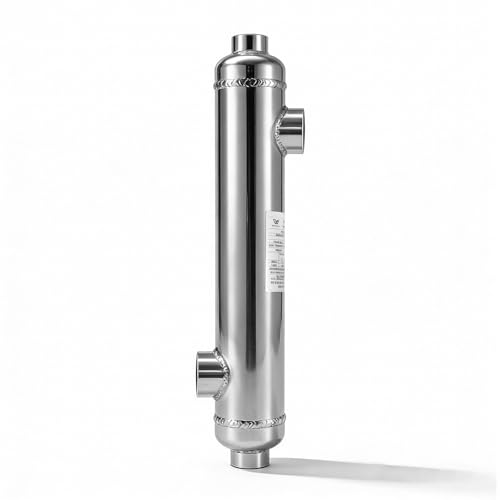
- 316L stainless steel for anti-corrosion durability
- 300 kBtu/hr rating for larger pools
- Compatible with boilers, solar, spa, and hydronic systems
Best For: Larger pools and multi-use heating systems needing higher capacity
Compact 316L Pool Heat Exchanger
- 316L stainless steel resists corrosion
- Spiral twist baffle design boosts heat transfer
- Compact 55 kBtu/hr unit for smaller systems
Best For: Smaller pools, spas, and hot tubs with limited space
High-output stainless pick
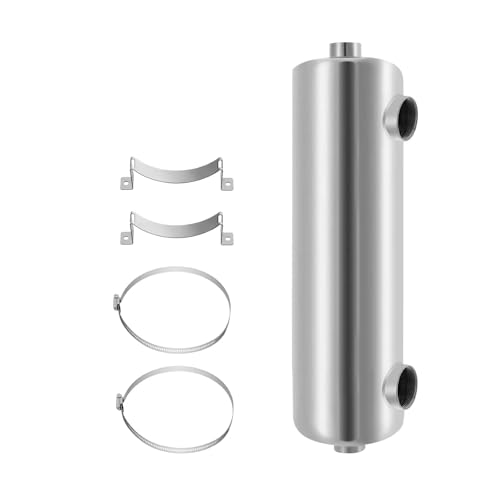
- 200 kBtu/hr output for fast heat transfer
- 304 stainless steel is rustproof and saltwater compatible
- 1" and 1.5" FPT ports support flexible plumbing
Best For: Fast, durable heating for pools, spas, and hot tubs
Heavy-duty 316L option
210K BTU 316L same-side exchanger
- 316L stainless steel for anti-corrosion durability
- 210 kBtu/hr rating supports larger heating jobs
- Same-side 1 1/2" FPT ports simplify setup
Best For: Corrosion-resistant heating in pools, spas, and hydronic systems
Balanced value stainless pick
200K BTU 304 exchanger with brackets

- 304 stainless steel is durable and salt water resistant
- 200 kBtu/hr output supports fast heating
- Includes 2 sets of fixed brackets
Best For: Buyers who want a practical 304 stainless exchanger with mounting support
High-Capacity Stainless Pick – AB 300K 316L Same-Side Pool Heat Exchanger
This pool heat exchanger is built for larger freshwater pool, spa, hot tub, and solar-heating setups that need strong transfer capacity. With 316L stainless steel construction and same-side ports, it suits permanent installations where corrosion resistance and straightforward plumbing matter.
Best For: Larger pools up to 23,800 gallons, plus spa and solar-heating systems
Pros:
- Up to 300 kBtu/hr capacity for demanding heating loads
- 316L stainless steel construction helps resist chemical treatment and corrosion
- Same-side 2″ FPT pool ports and 1 1/2″ FPT hot-water ports simplify connections
- Works with wood furnaces, hydronic systems, floor radiant heat, snow melting, and solar water heating
Cons:
- Made for permanent installation rather than quick portable use
- Best suited to freshwater applications, not specifically saltwater-focused
- Large capacity may be more than needed for smaller pools
If you need a high-capacity pool heat exchanger for a bigger residential system, this model offers broad heating compatibility and durable stainless construction. The same-side port layout also makes it easier to integrate into a planned plumbing setup.
Compact Shell-and-Tube Pick – RIYI 210K Compact Shell-and-Tube Exchanger
This pool heat exchanger is aimed at pool systems that benefit from a compact shell-and-tube design and efficient flow. The triple-pass tube bundle, low pressure drop, and included brackets make it a practical option for users connecting to heat pumps, solar panels, or gas boilers.
Best For: Pools and tanks needing a compact exchanger with flexible heat-source compatibility
Pros:
- Triple-pass tube bundle is designed to improve thermal efficiency
- Compact layout helps reduce pressure loss and support higher flow velocity
- Compatible with heat pumps, solar panels, and gas boilers
- Stainless steel or titanium alloy options support different water conditions
Cons:
- Stainless steel version is described as ideal for freshwater, not saltwater
- Lower 210kBtu rating than larger high-output models
- Specific heat-source and plumbing needs may still require careful system matching
For buyers comparing pool heat exchanger designs, this model stands out for its compact routing and system flexibility. It is a good fit when you want efficient heat exchange without a bulky footprint.
High-Output Performance Pick – VEVOR 360K 316L Pool Heat Exchanger
If you want a pool heat exchanger with strong output and a focus on efficient transfer, this VEVOR model is built for demanding heating jobs. Its 316 stainless steel tubing, large heat-transfer area, and sealed brazed construction are designed for reliable water-to-water heating in indoor or outdoor setups.
Best For: Spa, hot tub, and pool owners who want high heat capacity and durable construction
Pros:
- 360K BTU/h capacity for high-demand heating applications
- 7.4 ft² heat-transfer area with 30 capillary tubes
- 316 stainless steel construction is built for humid environments and high temperature/pressure use
- High-pressure vacuum brazing and leak testing add confidence in service life
Cons:
- Larger output may be unnecessary for smaller pool setups
- Heavier than smaller exchangers at 17.64 pounds
- Applications are broad, but system compatibility still depends on your plumbing and heat source
This is a strong pool heat exchanger choice if your priority is capacity and durability rather than a minimalist footprint. The combination of 316 stainless construction and a large transfer area makes it suited to consistent, long-term use.
Saltwater-Ready Titanium Pick – AB Titanium Opposite-Port Salt Pool Exchanger
AB Titanium Salt Pool Heat Exchanger 155kBtu Opposite Ports 1 1/2" & 1" FPT for 11,900 Gallon Pool
Check Price On AmazonThis pool heat exchanger is designed for challenging water conditions where corrosion resistance matters most. Made from 99.99% pure titanium with opposite-side ports, it is a practical fit for salt pools, seawater, and chemical-heavy environments that can be tough on standard materials.
Best For: Saltwater pools and specialized water or cooling applications
Pros:
- 99.99% pure titanium construction is built for high chlorine, salt water, and seawater
- Lightweight design makes installation easier
- Opposite-side 1 1/2″ FPT pool ports and 1″ FPT hot-water ports
- Suitable for mariculture, aquaculture, water treatment, desalination, and lab use
Cons:
- Lower 155 kBtu/hr capacity than larger residential pool models
- Designed for a smaller 11,900-gallon pool capacity
- Specialty material and use case may be more than needed for standard freshwater pools
For buyers focused on corrosion resistance, this pool heat exchanger is the most specialized option in the lineup. Its titanium build and saltwater-friendly profile make it especially compelling for harsh-water installations.
Compact 304 Stainless Pool Heat Exchanger – 200 kBtu Home & Spa
If you need a pool heat exchanger for a smaller pool, spa, or hot tub setup, this 304 stainless-steel unit offers a simple, space-saving way to transfer heat efficiently. It’s designed to minimize pressure loss, and its compact format with a mounting bracket makes it easier to fit into tighter installations.
Best For: Homeowners and fitness enthusiasts who want an efficient heating option for pools, spas, hot tubs, or solar-assisted setups.
Pros:
- 304 stainless steel construction resists rust and saltwater.
- 200 kBtu/hour output supports efficient heat transfer.
- Compact design includes a stainless steel mounting bracket.
- Compatible with pools, spas, hot tubs, and solar heating systems.
Cons:
- Solar panels are not included.
- Best suited to modest residential-style installations rather than larger commercial systems.
Overall, this is a practical pool heat exchanger if you want durable materials and straightforward installation in a compact footprint. Its strength is efficient heat transfer for common backyard water-heating setups.
Heavy-Duty 316L Pool Heat Exchanger – 300 kBTU Outdoor Systems
This pool heat exchanger is built for bigger heating jobs, with 316L stainless steel construction and a 300 kBtu/hr rating. The opposite-port layout and broad compatibility make it a strong fit for pool, spa, hot tub, solar, and boiler-based heating systems where durability and higher output matter.
Best For: Larger pools and multi-use heating systems that need a corrosion-resistant exchanger with higher capacity.
Pros:
- 316L stainless steel is designed for anti-corrosion performance.
- 300 kBtu/hr capacity suits pools up to 23,800 gallons based on the stated conditions.
- Works with outdoor wood boilers, solar water heating, hydronic heating, and more.
- Includes a 1-year warranty.
Cons:
- Larger size may be less convenient for compact equipment spaces.
- Port layout and sizing may require careful plumbing planning.
For buyers who want a higher-capacity pool heat exchanger with wide system compatibility, this model stands out on output and material quality. It’s especially appealing when corrosion resistance and versatility are priorities.
Compact 316L Pool Heat Exchanger – 55kBtu Same-Side Ports
AB Swimming Pool Heat Exchanger 55kBtu Stainless Steel 316L Same Side Ports 1 1/2" & 1" FPT
Check Price On AmazonIf you’re shopping for a smaller pool heat exchanger, this 55 kBtu model keeps things simple with a compact footprint and same-side ports. It uses 316L stainless steel for corrosion resistance and a spiral twist baffle design that helps improve turbulence and reduce scale buildup.
Best For: Smaller pools, spas, and hot tubs that need a compact exchanger for residential heating setups.
Pros:
- 316L stainless steel construction helps resist corrosion.
- Spiral twist baffle design improves turbulence and heat transfer.
- Compact size is easier to place in tight equipment areas.
- Compatible with pool, spa, hot tub, and solar water heating applications.
Cons:
- 55 kBtu/hr output is better suited to smaller systems.
- Same-side ports may not match every plumbing layout.
This is a practical choice when you want a smaller pool heat exchanger with efficient internal flow design and corrosion-resistant materials. It’s best viewed as a fit-for-purpose unit for modest heating demands.
High-output stainless pick – 200K BTU 304 heat exchanger
If you want a pool heat exchanger that can move heat quickly, this 200 kBtu/hr 304 stainless model is built for fast indirect heating in pools, spas, and hot tubs. It uses a sealed design with 1″ and 1.5″ FPT ports, making it a practical choice for saltwater-compatible systems where rust resistance and efficient heat transfer matter.
Best For: Pool and spa owners who want fast heating with a rustproof, saltwater-compatible unit.
Pros:
- 200 kBtu/hr output supports fast heating based on a 60°C temperature difference.
- 304 stainless steel construction is rustproof and suitable for chlorine or saltwater pools.
- Indirect, sealed heating design avoids open flame and leakage concerns.
- 1″ and 1.5″ FPT ports add flexibility for plumbing integration.
Cons:
- Requires a separate hot water or steam circuit to operate.
- Best performance depends on the right temperature difference and flow conditions.
This is a strong fit if your priority is quick heat transfer and durable construction over extra features. Its straightforward design and broad application range make it a solid pool heat exchanger for both residential setups and utility-style heating tasks.
Heavy-duty 316L option – 210K BTU 316L same-side exchanger
This pool heat exchanger is built around 316L stainless steel and a 210 kBtu/hr rating, making it a strong choice when corrosion resistance and high heating capacity are top priorities. With same-side 1 1/2″ FPT ports for both pool water and hot water, it is aimed at straightforward integration in pool, spa, and hydronic setups.
Best For: Buyers who want a corrosion-resistant 316L exchanger for pools and multi-use heating systems.
Pros:
- 316L stainless steel construction is designed for anti-corrosion performance.
- 210 kBtu/hr capacity supports heating up to 17,200 gallons based on the listed conditions.
- Same-side 1 1/2″ FPT ports simplify connection planning.
- Useful for pool, spa, hot tub, solar, wood furnace, and hydronic applications.
Cons:
- Uses 1 1/2″ ports only, so it may not suit smaller plumbing configurations.
- Performance is tied to the stated temperature-difference conditions.
If you want a pool heat exchanger with a stronger corrosion-resistance focus, this 316L model stands out. It is especially appealing for users who want one unit that can support both pool heating and broader system applications.
Balanced value stainless pick – 200K BTU 304 exchanger with brackets
For shoppers comparing pool heat exchanger options, this 304 stainless unit offers the familiar 200 kBtu/hr class of heating performance in a compact, indirect design. It is intended for swimming pools, spas, and hot tubs, and the included fixed brackets can make installation feel more organized.
Best For: Owners who want a durable, salt water resistant exchanger with included mounting brackets.
Pros:
- 304 stainless steel construction is durable and salt water resistant.
- 200 kBtu/hr output supports relatively fast heating.
- Indirect heat transfer design is described as safe with no open flame or leakage.
- Includes 2 sets of fixed brackets for mounting support.
Cons:
- Lower-spec 304 steel may not match the corrosion resistance of 316L units.
- Like other exchangers, it needs a compatible hot water or steam source.
This model is a sensible middle-ground choice if you want proven heating output and easier mounting without moving into a higher-priced 316L build. It covers the core needs of a pool heat exchanger well and keeps the design focused on efficiency and safety.
How We Picked the Best Pool Heat Exchanger
We focused on specifications that matter most in real-world use: BTU output, stainless steel or titanium construction, port size and orientation, and compatibility with pool, spa, hot tub, solar, or boiler systems. We also looked for options that suit different pool capacities, from smaller backyard setups to larger systems needing higher output.
Quick Comparison
Use BTU rating as your first filter. Lower-output units are better for smaller pools or spas, while higher-output units are better when you need faster recovery time or are heating larger water volumes. Material matters too: 316L stainless steel is a strong choice for many systems, while titanium is the safer pick for aggressive saltwater conditions.
Key Buying Factors for a Pool Heat Exchanger
Capacity and BTU Rating
Match the heat exchanger output to your pool or spa size and your desired heating speed. An undersized unit may run continuously without reaching target temperature, while an oversized one may add unnecessary cost.
Material and Water Chemistry
316L stainless steel is widely used for durability and corrosion resistance, but saltwater systems and harsh chemistry often benefit from titanium. If your water is chlorinated or balanced carefully, stainless steel may be sufficient.
Port Size and Layout
Check both port diameter and whether the ports are on the same side or opposite sides. This affects how easily the unit fits into your existing plumbing and where you can mount it.
System Compatibility
Make sure the exchanger is compatible with your heat source, whether that is a boiler, solar setup, wood stove loop, or another water-to-water application. Flow direction, bracket options, and connector type should all be verified before purchase.
Who Should Buy Which Pool Heat Exchanger?
If you want maximum heating power for a larger pool, look for higher-BTU stainless steel units. If you have a smaller spa or hot tub, a compact lower-output model may be more efficient and easier to install. For saltwater pools, titanium is usually the safer long-term choice. If you are replacing an existing system, prioritize port size and orientation first so installation stays straightforward.