Choosing a marine VHF radio with AIS can make a real difference in safety, situational awareness, and day-to-day boating confidence.
Below, we focus on options that balance signal clarity, AIS visibility, GPS integration, and mounting style so you can find the right fit for your boat.
Best 10 Marine Vhf Radio with Ais Picks for 2026
Lowrance AIS-Ready Pick
Link-9 VHF Marine Radio with AIS-RX

- AIS-RX plus DSC support
- NMEA 2000 and NMEA 0183 compatible
- IP68 waterproof rating
Best For: Boats needing AIS receive and NMEA networking
Icom Networked AIS Choice
M510 EVO VHF with AIS and NMEA 2000

- Built-in AIS support
- NMEA 2000 connectivity
- 50 VHF channels
Best For: Helm setups that rely on NMEA 2000 networking
Uniden Safety-Focused Option
UM725GBT VHF with GPS, Bluetooth, and Weather
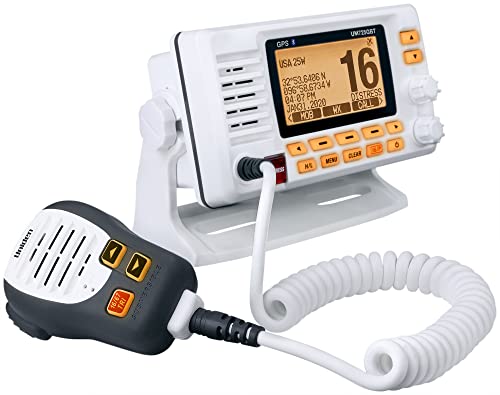
- Built-in GPS and Bluetooth
- NOAA weather channels and alerts
- IPX8 waterproof with DSC
Best For: Boaters who want GPS and weather features, not AIS
Simrad Integrated AIS Model
RS40-B VHF with Class B AIS and Hailer

- Integrated AIS and GPS receivers
- Hailer function included
- NMEA 0183 and NMEA 2000 support
Best For: Boats wanting integrated AIS, GPS, and hailer capability
Compact GPS Fixed Mount
Icom IC-M330G Ultra Compact VHF Marine Transceiver with GPS

- Palm-sized fixed-mount chassis for tight installs
- Built-in GPS/GLONASS/SBAS for DSC position calls
- Class D DSC with clear, loud audio output
Best For: Small boats and compact helm spaces
Connected AIS Fixed Mount
FIXED MOUNT VHF/GPS/AIS/NMEA2000

- Built-in AIS support with internal GPS
- NMEA2000 plus Bluetooth for system integration
- 66 channels and weather-resistant construction
Best For: Modern boats needing AIS and network connectivity
Floating Handheld AIS Radio
Icom M94D 21 USA VHF Marine Transceiver

- Integrated AIS receiver shows nearby traffic
- Float’n Flash design with MOB distress function
- 6W transmit power with up to 10 hours battery life
Best For: Boaters wanting a portable AIS-equipped handheld
Value-Focused Fixed Mount
Uniden UM385BK 25 Watt Marine VHF

- 25-watt fixed-mount VHF radio
- DSC distress and position features
- IPX4 waterproof with weather alerts
Best For: Boat owners who want a rugged fixed-mount radio with weather alerts and DSC support
Compact GPS Safety Pick
Icom IC-M330G Ultra Compact VHF

- Built-in GPS/GLONASS/SBAS receiver
- Ultra-compact chassis for tight installs
- Class D DSC with IPX7 waterproofing
Best For: Small boats and tight helm spaces that need built-in GPS and DSC safety support
Ultra-Compact Basic Mount
- Ultra-compact fixed-mount VHF radio
- Class D DSC safety monitoring
- Supports NMEA 0183 or NMEA 2000
Best For: Buyers who want a compact VHF radio with DSC safety features and external navigation support
Lowrance AIS-Ready Pick – Link-9 VHF Marine Radio with AIS-RX
If you want a marine vhf radio with ais reception built in, the Lowrance Link-9 is a practical fixed-mount option for boats already running NMEA 2000 or NMEA 0183 gear. It combines DSC, AIS-RX, and a clear white dot-matrix LCD, so it suits operators who want straightforward visibility and compatibility rather than extra smartphone features.
Best For: Boat owners who want AIS receive capability plus broad NMEA integration in a fixed VHF setup.
Pros:
- Includes AIS-RX and DSC for added situational awareness and distress calling.
- Compatible with NMEA 2000 and NMEA 0183 devices.
- Large clear white dot-matrix LCD is easy to read.
- IP68 waterproof rating for strong marine protection.
Cons:
- Only 2 channels are listed in the supplied specs.
- Maximum talking range is listed at 6 miles.
- Heavier than some compact radios at 5.6 pounds.
This is a good fit if your priority is AIS reception, solid waterproofing, and direct network compatibility with existing onboard electronics. It is less about flashy extras and more about dependable core marine radio functions.
Icom Networked AIS Choice – M510 EVO VHF with AIS and NMEA 2000
The Icom M510 EVO is a marine vhf radio with ais support aimed at boaters who want networked communication in a compact fixed-mount package. With AIS and NMEA 2000 compatibility, it fits well into a modern helm setup where the radio needs to share data with other onboard electronics.
Best For: Boat owners looking for an AIS-capable VHF radio that works over NMEA 2000.
Pros:
- Built-in AIS adds traffic awareness.
- NMEA 2000 compatibility supports onboard networking.
- 50 channels provide broad VHF coverage.
- Water-resistant design for marine use.
Cons:
- Maximum talking range is listed at 5 miles.
- No waterproof IP rating is provided in the notes.
- Fewer listed extras than some feature-heavy radios.
If you want AIS in a radio that plugs into a NMEA 2000 ecosystem, this model keeps the focus on essential function and system integration. It is a sensible choice for helms where networking matters more than extra consumer-style features.
Uniden Safety-Focused Option – UM725GBT VHF with GPS, Bluetooth, and Weather
The Uniden UM725GBT is a feature-packed marine vhf radio, but it does not list AIS in the supplied specs. Instead, it focuses on GPS, Bluetooth, NOAA weather channels, DSC distress send and receive, and a large LCD screen, making it a strong general-purpose safety radio for boaters who want modern convenience.
Best For: Boaters who want GPS, Bluetooth, and weather features in a marine VHF radio.
Pros:
- Built-in GPS receiver helps with distress signaling.
- Bluetooth lets it connect to a smartphone.
- NOAA weather channels and alerts are included.
- IPX8 waterproof rating and DSC support add confidence.
Cons:
- No AIS feature is listed in the supplied notes.
- Does not match buyers specifically seeking AIS reception.
- Best suited to standard VHF and safety use rather than AIS integration.
This model stands out for convenience and visibility rather than AIS capability. If AIS is a must-have, it is not the right fit, but it remains a strong option for GPS-enabled marine communication and weather monitoring.
Simrad Integrated AIS Model – RS40-B VHF with Class B AIS and Hailer
The Simrad RS40-B is a marine vhf radio with ais features built for boats that want integrated traffic awareness and networking support. With built-in AIS and GPS receivers plus a hailer, it is aimed at users who want a more advanced fixed-mount communication package.
Best For: Boaters who want a Class B AIS-equipped VHF radio with integrated GPS and hailer functions.
Pros:
- Integrated AIS and GPS receivers are built in.
- Includes a hailer for additional onboard communication.
- Supports NMEA 0183 and NMEA 2000 connectivity.
- IP67 waterproof rating for marine durability.
Cons:
- Only 8 channels are listed in the supplied specs.
- Maximum talking range is listed at 23 miles.
- Heavier unit at 5.8 pounds.
This is the most feature-rich AIS option in the group if you want built-in receivers and hailer capability together. It makes the most sense for boaters who want a network-friendly radio with stronger integrated navigation features.
Compact GPS Fixed Mount – Icom IC-M330G Ultra Compact VHF Marine Transceiver with GPS
If you want a marine vhf radio with ais-style safety features in a compact fixed-mount package, the Icom IC-M330G is built for tight installs without giving up core distress and position-call functions. Its built-in GPS/GLONASS/SBAS receiver, Class D DSC monitoring, and strong audio make it a practical choice for smaller helms and busy waters.
Best For: Small boats, tight consoles, and boaters who want a compact fixed-mount VHF with integrated GPS and DSC safety tools.
Pros:
- Palm-sized chassis fits small consoles and tight helm spaces.
- Built-in GPS/GLONASS/SBAS supports accurate DSC position calls.
- Class D DSC continuously monitors Channel 70 for distress and safety calls.
- Loud, clear speaker design helps in noisy marine environments.
Cons:
- Does not list a built-in AIS receiver in the supplied details.
- Fixed-mount design is less flexible than a handheld radio.
Overall, the IC-M330G is a strong pick if installation space is limited and you want dependable VHF communication with GPS-backed safety features. It focuses on clarity, ease of use, and compact mounting rather than advanced AIS display capability.
Connected AIS Fixed Mount – FIXED MOUNT VHF/GPS/AIS/NMEA2000
This fixed-mount marine vhf radio with ais is aimed at boaters who want a more connected radio setup with internal GPS, AIS support, and NMEA 2000 compatibility. With Bluetooth, smartphone/tablet compatibility, and a weather-resistant build, it fits well in boats that need both communication and system integration.
Best For: Boaters who want a fixed-mount radio with AIS, internal GPS, and easy integration into a modern onboard network.
Pros:
- Built-in AIS support plus internal GPS in one fixed-mount unit.
- NMEA2000 connectivity makes integration easier on compatible boats.
- Bluetooth adds smartphone and tablet compatibility.
- 66 channels and a 25-mile maximum talking range listed in the details.
Cons:
- The supplied notes are brief and do not provide as much operating detail as the others.
- More networked features may be unnecessary for simple VHF-only users.
If you want a radio that leans into AIS and boat-network integration, this model stands out as the most feature-forward fixed-mount option here. It is best suited to owners who value connectivity and onboard system compatibility as much as basic VHF use.
Floating Handheld AIS Radio – Icom M94D 21 USA VHF Marine Transceiver
If you want a handheld marine vhf radio with ais for portable safety and navigation support, the Icom M94D brings AIS reception, DSC, and waypoint guidance into a floating handheld design. It is built for skippers who want nearby vessel traffic on screen and the flexibility to carry the radio anywhere on board.
Best For: Boaters who want a floating handheld VHF with AIS reception, DSC, and onboard portability.
Pros:
- Integrated AIS receiver shows nearby vessel traffic on screen.
- DSC and AIS target call simplify individual calls and distress alerts.
- Float’n Flash design and MOB function add overboard safety.
- 6W transmit power and up to 10 hours of typical battery life.
Cons:
- Handheld design has a shorter maximum talking range listed than fixed-mount units.
- Only 4 channels are listed in the supplied details.
The M94D is the most portable choice in this group and a strong option if AIS viewing and safety features matter more than permanent installation. Its floating design, clear audio, and waypoint support make it especially useful for smaller boats and active day boating.
Value-Focused Fixed Mount – Uniden UM385BK 25 Watt Marine VHF
If you want a marine vhf radio with ais-style safety features in a compact fixed-mount package, the Uniden UM385BK is built around communication, weather alerts, and distress calling. It offers 25 watts of power, triple watch, DSC capability, and S.A.M.E. weather alert support, making it a practical pick for everyday boating where clear marine communication matters.
Best For: Boat owners who want a rugged, feature-rich fixed mount with weather alerts and DSC emergency support.
Pros:
- 25-watt fixed-mount design for strong marine VHF performance
- DSC with distress button, position send, and request functions
- Includes triple watch and S.A.M.E. weather alert support
- IPX4 waterproof rating for protection against rain and splashing water
Cons:
- No built-in AIS function
- Not as compact as ultra-small helm radios
The UM385BK stands out if you value dependable core safety tools over advanced navigation extras. It is a solid, straightforward marine radio for users who want weather awareness, emergency calling, and a durable fixed-mount setup.
Compact GPS Safety Pick – Icom IC-M330G Ultra Compact VHF
The Icom IC-M330G is a strong choice if you’re shopping for a marine vhf radio with ais-adjacent safety benefits in a small, easy-to-install package. Its built-in GPS/GLONASS/SBAS receiver supports accurate DSC calls, while the class D DSC system continuously monitors Channel 70 for distress, safety, and position-related calls.
Best For: Small boats and tight helm spaces where built-in GPS and DSC safety features are a priority.
Pros:
- Ultra-compact chassis fits small consoles and tight spaces
- Built-in GPS/GLONASS/SBAS helps support accurate DSC positioning
- Class D DSC monitors Channel 70 for distress and safety calls
- IPX7 waterproof rating for better water protection
Cons:
- No built-in AIS capability
- Shorter listed talking range than some full-size fixed-mount radios
For buyers who want a small radio with integrated position data and reliable DSC handling, the IC-M330G is an excellent fit. It focuses on safety, clear audio, and compact installation rather than extra navigation features.
Ultra-Compact Basic Mount – Icom IC-M330 Without GPS
The Icom IC-M330 is a straightforward marine vhf radio with ais-style safety fundamentals, but without the built-in GPS module found on the G version. It keeps the same ultra-compact chassis, clear audio design, and Class D DSC monitoring, making it a practical fixed-mount option when you want dependable VHF communication in a simple package.
Best For: Buyers who want a compact fixed-mount VHF radio with DSC safety features and flexible connectivity.
Pros:
- Ultra-compact design for easy installation in tight helm spaces
- Class D DSC monitors Channel 70 for distress and safety calls
- Clear speaker design for loud, distortion-free audio
- Supports NMEA 0183 or NMEA 2000 connectivity
Cons:
- No built-in GPS
- No AIS functionality listed
If you already have external navigation equipment, the IC-M330 gives you the essentials in a small, durable radio. It is best treated as a compact communication-and-safety unit rather than a feature-heavy navigation hub.
How We Picked the Best Marine Vhf Radio with Ais
We prioritized radios that offer dependable VHF communication, useful AIS functionality, and practical features for real-world boating. We also considered display readability, waterproofing, GPS support, NMEA 2000 compatibility, and whether the radio suits a small center console, cruising sailboat, or larger vessel.
Quick Comparison
The best Marine Vhf Radio with Ais for you depends on how you boat. Fixed-mount units are usually better for permanent installations and higher power output, while handheld or ultra-compact models are better for redundancy and limited helm space. Some models add GPS and DSC for faster distress calling and location sharing, while others focus on simple, reliable communication with AIS reception or broader network integration.
Best Fit by Boat Type
Choose a compact radio if helm space is tight, a network-ready model if you already use NMEA 2000 electronics, and a feature-rich fixed mount if you want the most complete communication setup.
Key Buying Factors for Marine Vhf Radio with Ais
AIS capability: Confirm whether the unit receives AIS targets only or offers deeper integration with your chartplotter and onboard network. AIS reception improves awareness of nearby commercial traffic and nearby vessel movement.
GPS and DSC: Built-in GPS can simplify installation and support accurate distress signaling. DSC is important for sending emergency calls and improving routine safety communication.
Mounting and form factor: Fixed-mount radios are typically best for primary use, while handhelds or ultra-compact sets are useful as backups or for boats with limited panel space.
Display and controls: A larger, high-contrast screen is easier to read in glare, spray, and rough conditions. Oversized buttons and simple menus matter when conditions get busy.
Power and channel coverage: Most boaters should look for 25-watt transmit power and broad channel support for U.S., Canadian, and international waters if they cruise beyond local routes.
Who Should Buy Which Marine Vhf Radio with Ais?
Choose a premium networked model if you want the most seamless integration with modern electronics and the clearest navigation awareness. Pick a compact GPS-equipped unit if you want a clean installation with built-in safety features. Go with a basic fixed-mount or backup handheld-style option if your priority is reliable communication at a lower cost or as a secondary radio onboard.
For most buyers, the best choice comes down to three questions: how much space you have, whether you need AIS and GPS together, and how deeply you want the radio to connect with the rest of your marine electronics.